Taxi Cologne: What a Ride Costs and Why the Tariff Reaches Düsseldorf
Cologne charges a flat rate: every kilometre costs the same whether you ride two or forty. In return, the Cologne tariff applies across an area stretching from Bonn to Düsseldorf – and the next price rise is already written into the ordinance.

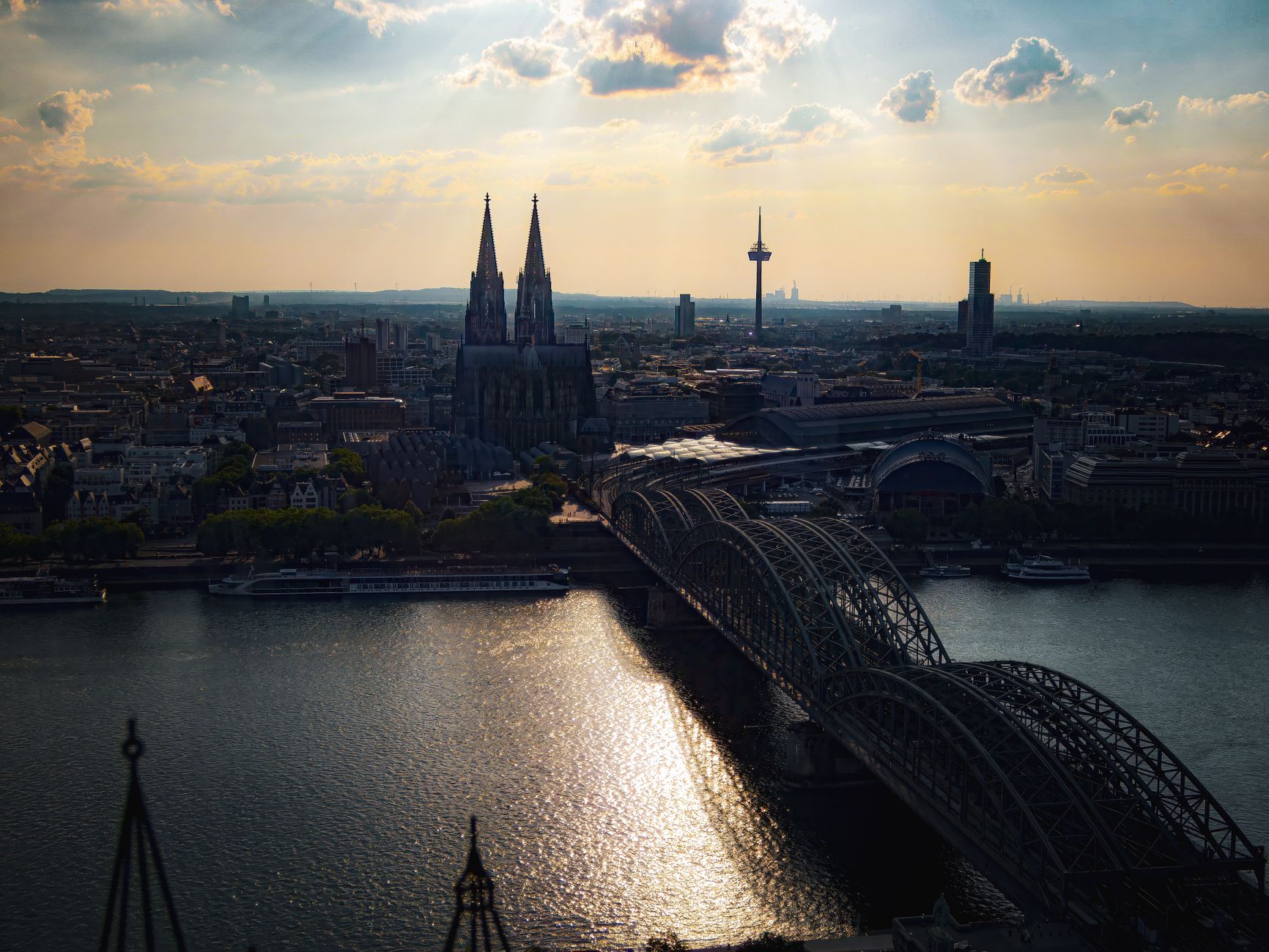
Get into a taxi in Cologne and the meter opens at €4.90 – a base fare that barely registers by German big-city standards. Where Cologne gets expensive is the kilometre. Since 1 June 2026 every kilometre costs €2.90, from the first to the last. There is no taper that makes long journeys cheaper, the way Munich, Hamburg and Berlin have one. That keeps the maths pleasantly simple and makes longer rides noticeably dear. And because the council voted through two rises in one go, you already know today what a Cologne taxi will cost from March 2027.
€4.90 to start, €2.90 a kilometre – and no taper
The legal basis is the Kölner Taxitarif, a municipal ordinance last amended on 2 April 2026. The council approved the change on 19 March 2026, citing higher staff and operating costs, above all the successive rises in the statutory minimum wage. Since 1 June 2026:
- Base fare: €4.90 – unchanged, and it already covers the first 34 metres or so
- Per kilometre: €2.90 – up from €2.60; the meter ticks up 10 cents every 34.48 metres
- Waiting time: 60 cents a minute – up from 50 cents, which works out at €36 an hour
The ordinance explicitly calls these fixed prices: they may be neither exceeded nor undercut. A driver can’t knock anything off the meter for you, and can’t charge more than it shows either.
Three worked fares on a clear road:
- 3 km – €4.90 + 3 × €2.90 = €13.60
- 8 km – €4.90 + 8 × €2.90 = €28.10
- 20 km – €4.90 + 20 × €2.90 = €62.90
Set against Munich, Cologne holds its own over short hops thanks to the lower base fare, then pulls ahead on longer runs, because Munich drops to €2.50 from the eighth kilometre. Frankfurt, like Cologne, runs a single flat per-kilometre rate, so a breakdown of Frankfurt’s taxi costs is the more like-for-like comparison. How the building blocks of a German taxi tariff fit together in general is covered in taxi fares in Germany.
The March 2027 rise is already decided
What’s unusual about the Cologne ordinance is that it already contains the next step. From 1 March 2027 the base fare goes to €5.00 and the per-kilometre rate to €3.00, with the meter ticking every 33.33 metres. Waiting stays at 60 cents a minute. For the three journeys above that means €14.00 instead of €13.60, €29.00 instead of €28.10, and €65.00 instead of €62.90.
Small change, you might think, but it adds up. Between the old tariff and March 2027 a Cologne taxi kilometre goes up by 40 cents in total – roughly 15 per cent. The council also resolved to review the effect after a year and to set up a round table with the taxi and private-hire trades.
Waiting time and the only surcharge
Stuck in traffic, or asking the driver to wait, you pay 10 cents every ten seconds – 60 cents a minute. Ten minutes crawling along the riverside road therefore adds six euros. A Cologne driver, incidentally, isn’t obliged to wait for you for longer than 15 minutes; the ordinance says so in as many words.
The Cologne tariff has exactly one surcharge: a higher base fare for large taxis. If you specifically order a people carrier, or more than four passengers travel, the base fare rises by €6.00, and by €7.00 from March 2027. There’s no night, weekend, luggage or airport supplement. Nor do you pay for the empty run to your door: the meter may only be switched on once the taxi reaches the pick-up address.
One local curiosity: drivers who have passed the chamber of commerce’s taxi-guide exam may run city tours at a set price of their own – €50 for the roughly one-hour Route 1 and €80 for the roughly two-hour Route 2. They carry an IHK ID card and often a sticker at the bottom right of the windscreen.
A service area from Bonn to Düsseldorf
This is where Cologne gets properly unusual. The Pflichtfahrgebiet – the area in which the official tariff applies and a taxi is obliged to take you – doesn’t stop at the city boundary. According to the ordinance it also takes in the cities of Bonn, Düsseldorf, Leverkusen and Solingen, the Rhein-Kreis Neuss, the Rhein-Erft-Kreis, the Rheinisch-Bergischer Kreis, the towns of Monheim, Langenfeld, Hilden, Haan, Erkrath and Mettmann, Euskirchen, Zülpich and Weilerswist, and the Rhein-Sieg-Kreis except Windeck, Eitorf and Ruppichteroth.
In practice, a Cologne taxi will take you to Bonn or Düsseldorf at the ordinary metered rate, with no haggling beforehand. Worked fares by road from the main station:
- Köln Hbf → Bonn Hbf, about 30 km: €4.90 + 30 × €2.90 = roughly €92
- Köln Hbf → Düsseldorf Hbf, about 39 km: €4.90 + 39 × €2.90 = roughly €118
If your journey ends outside this area, the driver must tell you before setting off that the fare for the whole trip is open to agreement. If that doesn’t happen and nothing is agreed, the Cologne tariff counts as the agreed price. For a rough idea of how far places in the region are, road distances and drive times from Cologne are a quick first check. The reverse doesn’t automatically hold: a Düsseldorf taxi charges by Düsseldorf’s rules, which are set out in taxi fares in Düsseldorf.
Main station to the trade fair: €16 for a walk across the river
The ride visitors take most often is from the Hauptbahnhof across the Rhine to Deutz – the Koelnmesse trade fair grounds or the LANXESS arena. As the crow flies it’s a stone’s throw, straight across the water. But a taxi can’t use the Hohenzollern Bridge, which carries only trains, pedestrians and cyclists; it has to go round via the Deutz Bridge or the Zoo Bridge. From the station to the fair’s South entrance that comes to about 3.8 km by road:
€4.90 + 3.8 × €2.90 = about €16 – with the roads clear.
During gamescom or Anuga the approaches to the fairground can turn sluggish, though, and then the 60 cents a minute starts running. Fifteen minutes in a queue quickly turns €16 into €25. My honest take on this one: walk across the Hohenzollern Bridge, which takes a good quarter of an hour and comes with the best view of the cathedral in town, or take an S-Bahn one stop to Köln Messe/Deutz. A taxi only really makes sense here with heavy bags or in a downpour. If you’re driving yourself to a big event, you’re usually better off using park-and-ride sites on the edge of Cologne and covering the last stretch by train.
Other city-centre staples from the main station, again without traffic: Neumarkt is about 2.3 km, so roughly €11.60; the RheinEnergieSTADION in Müngersdorf about 7.6 km, so roughly €27.
To Cologne Bonn Airport: €50-odd against €4
Cologne Bonn Airport sits in the district of Porz, within Cologne’s own city limits. From the main station it’s about 16 to 18 km by road depending on the route, around 20 minutes on a clear motorway. At today’s tariff:
- 16 km: €4.90 + 16 × €2.90 = €51.30
- 18 km: €4.90 + 18 × €2.90 = €57.10
- from March 2027, 16 to 18 km: €53 to €59
No airport supplement is added. The counter-argument is stark, though. The airport station is served by S-Bahn line S19 and regional trains, and since 1 June 2026 the new Rheinlandtarif applies across the region. Main station to airport falls into fare level 1b, and a single ticket costs €4.00 (as of 2026). Even four of you, at €16, pay far less by train than by taxi. There’s no “before the first train” here, either: the S19 is the one Cologne S-Bahn line that runs every half hour right through the night. So the taxi wins only if you’re starting from a district with poor rail links, facing two changes with children and a pile of suitcases, or unwilling to wait up to 30 minutes for a night train. And if you do take a cab to the terminal, knowing how departures work at Cologne Bonn, from check-in to gate will save you more time than any shortcut on the A59. What the ride from the airport on to Bonn costs, and why the SB60 express bus there is due to stop in December 2026, is covered in Cologne Bonn Airport transfer.
Fixed prices by app: the corridor now reaches 20 per cent below
Book by phone or app with a fixed start and destination, and the operator may quote a fixed price instead of running the meter. Cologne’s tariff corridor used to be lopsided: at most 5 per cent below and 20 per cent above the tariff. Since June 2026 it’s 20 per cent either way. The basis is the base fare, the per-kilometre rate and, where relevant, the large-taxi supplement; waiting time is expressly left out, and the run to your door is free.
For the 16 km airport trip, that means: metered, it’s €51.30; an agreed fixed price may sit anywhere between roughly €41 and €62. You must receive a confirmation showing the price, date and time before the journey, usually by app or text. The new lower end is the interesting part: when business is quiet, dispatchers can now quote prices noticeably below the meter. If a quote sits at the top of the corridor, it only pays when you expect traffic – because with a fixed price the jam is the operator’s problem, not yours.
Taxi Ruf, apps and the row over minimum fares for Uber
The largest dispatcher is Taxi Ruf Köln eG, founded in 1937, with just under 1,200 affiliated taxis by its own count. Within Cologne you reach it on the short number 2882 (0221 2882 from outside), or through the taxi.eu app. On top of that, taxis wait at around 140 ranks across the city, the best known of them at the main station.
Uber, Bolt and FreeNow all operate in Cologne, but much of what they dispatch is private hire rather than taxis, and private hire has no official tariff. The city tried to change that with a general order introducing a minimum fare from 1 June 2026: private-hire rides were to cost no more than 20 per cent less than the taxi tariff. On 24 July 2026 the Cologne Administrative Court suspended the rule in summary proceedings (ref. 18 L 1226/26), partly because the mayor had acted without a council resolution and partly because the rule reached beyond the city’s boundaries. The city has appealed to the Higher Administrative Court in Münster; when it will rule is open. What this means for app prices is put in context in Bolt prices in Germany. Until then, compare the app quote with the metered fare before you book – especially during big events, when platform surge pricing climbs and the taxi tariff doesn’t.
In the end a Cologne taxi comes down to one number: €2.90 a kilometre, €3.00 from March 2027, with no discount for distance. Hopping across the Rhine it’s affordable; to the airport or on to Düsseldorf it quickly heads towards three figures – and that’s exactly where it pays to look at the train or a fixed price before you get in. All figures are as of 2026; the binding tariff summary hangs on a yellow sign within sight of the back seat in every Cologne taxi.
Keep reading
Taxi & Fares
Taxi Düsseldorf: What a Ride Costs and Where the €25 Fixed Fare Applies
Düsseldorf taxi fares 2026: a €5 base fare, €2.70 per kilometre, €43 an hour waiting, a €2 airport supplement and a fixed price between the airport and the trade fair – with worked fares across the city.
Jonas Reinhardt25 September 2026
Taxi & Fares
Taxi Leipzig: What a Ride Costs Under the 2026 Tariff
Leipzig taxi fares 2026: a €4.50 base fare, €3.30 per km for the first three kilometres, then €2.40 and €2.20, €40 an hour waiting – with worked fares to the trade fair, the Red Bull Arena and Leipzig/Halle Airport.
Jonas Reinhardt25 September 2026
Taxi & Fares
Taxi Nuremberg: the Tariff Since June 2026 and What Rides Really Cost
Nuremberg taxi fares 2026: a €4.90 minimum fare, €5.10 for the first kilometre, then €2.70 and €2.20, €40 an hour waiting time – with worked fares to the trade fair, the airport and the Documentation Centre.
Jonas Reinhardt25 September 2026
Taxi & Fares
Taxi Hanover: What the Ride Costs and Why One Tariff Reaches Past the City Limits
Hanover taxi tariff 2026: €4.50 base fare, €2.80 per kilometre, €35 an hour waiting, no night surcharge – and fixed prices bookable by app since September 2025.
Jonas Reinhardt5 August 2026
Taxi & Fares
Taxi Dresden: Fares, Fixed Airport Prices and the 2027 Rise
Dresden taxi fares 2026: a €4.90 base fare, €3.20 per km for the first four kilometres, then €2.60 and €2.40, a fixed €48 from the airport to the Hauptbahnhof – with worked fares to the Frauenkirche and the second step due in January 2027.
Jonas Reinhardt25 September 2026