Booking a Taxi in Berlin: Phone, App or Rank
The tariff is the same for everyone in Berlin, but getting hold of the car runs through four different routes, and not every one suits every situation. Here are the dispatch numbers, the apps, the ranks and the wheelchair-accessible exception, all as of 2026.

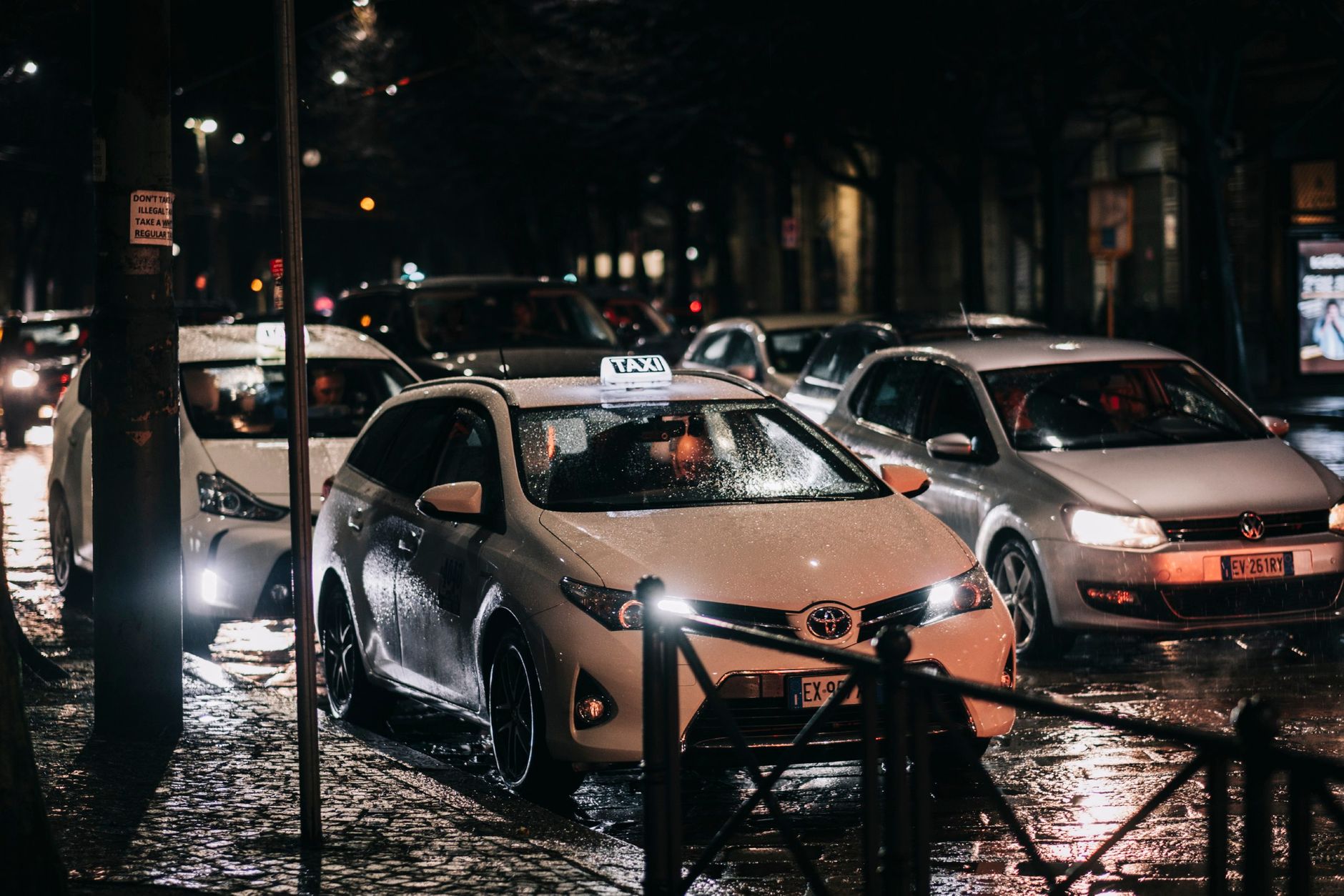
The Berlin tariff is set by the authorities and the same for everyone — that’s covered in full in Taxis in Berlin: what the ride costs. What that piece deliberately leaves out is the question that actually hits you first: how do you get hold of the car in the first place? And the answer isn’t nearly as uniform as the price. Berlin doesn’t run on one taxi firm or one booking number — it has a good dozen competing dispatch centres, two apps worth knowing, hundreds of ranks, and a fairly small slice of the fleet that can actually take a wheelchair. Whether you need to be at the airport by six in the morning, you’re trying to get away from a side street in Charlottenburg late at night, or you’re travelling with a wheelchair, a different route is the right one — and picking the wrong one can, worst case, cost you the flight. Here’s what actually works in 2026: which number to dial, what separates the apps, when hailing beats the rank, and how far ahead you need to book so a car genuinely turns up.
Phoning It In: The Dispatch Centres and Their Numbers
The old-fashioned route is still the fastest one when you need a car right now and can’t be bothered opening an app: pick up the phone. Berlin runs several independent radio-dispatch centres, and the best known simply calls itself Taxi Berlin, reachable around the clock on 030 20 20 20. The number has been in circulation for decades, every driver in the city knows it, and it dispatches from a large pool of affiliated vehicles right across Berlin.
Alongside it sits Würfelfunk on 030 21 01 01, a separate centre with its own fleet. In practice it makes little difference which of the two you call — both dispatch regular, licensed taxis at the same regulated tariff. If one is overloaded, or thin on cars in your part of town, just try the other.
If you don’t fancy remembering a number, there’s taxi.eu: the platform connects you by phone, around the clock, to one of Berlin’s dispatch centres, and also offers automatic online booking that it says confirms within seconds. BER airport has its own number too, 030 8105 88888, which books you straight onto the rank at the terminal.
One warning that can save you real money: nationwide taxi-call numbers circulate, such as 19410 (allocated by the Federal Network Agency back in the 1990s, standard landline rate) and 22456 (run by a private operator since 2006, considerably pricier from a mobile at up to €0.69 a minute). Both route you through to a local centre, but can cost several times what a direct call to Taxi Berlin or Würfelfunk would. In Berlin, the detour via a national number is barely ever worth it — the city has plenty of dispatch centres of its own.
The call itself doesn’t carry a booking fee — the tariff doesn’t provide for one. You pay only for the ride, whether metered or at an agreed fixed price.
The Apps: FreeNow versus Taxi Deutschland
If you’re glued to your phone anyway, the app usually gets you there faster than a phone call these days — provided it’s the right app.
FreeNow is the most widely used taxi app in Berlin, and here it dispatches mostly regular, licensed taxis. The map shows which cars are free nearby, you get a price estimate before confirming, and payment runs cashless through the app. FreeNow advertises an average pickup time of around three minutes across its network — how fast it actually is for you depends on the time of day and the neighbourhood. Useful for planning ahead is the pre-booking feature: set the date, time and destination, and the app schedules a car to match. It also covers airport pickups, BER included.
Taxi Deutschland isn’t a single company but a co-operative of German dispatch centres — the organisation describes itself as the umbrella body for Germany’s taxi centrals. Through the identically named app (Android and iOS, redesigned as of November 2024), the operator says more than 50,000 taxis nationwide can be booked through it, Berlin’s centres among them. The difference from FreeNow is structural: you’re booking more directly through the local dispatch network rather than a pan-European platform, which can mean a more direct line for unusual requests — a large vehicle, a specific type of car.
There’s a third option many people miss: since June 2024, the Uber app has carried a product option called Uber Taxi, which books you a regular Berlin taxi at a fixed price agreed up front, not a private-hire car. How that differs legally from a standard Uber booking is something I work through in Uber or taxi in Berlin.
For an everyday short hop, which app you use barely matters — what matters is having one installed before you need it.
Hailing or the Rank: Where the Difference Lies
You can skip the phone and the app altogether, and in the centre that’s often the fastest route: flag down a free taxi in the street, or get in at a rank.
A taxi is free when its roof light is lit. If it drives past with the light off, it’s occupied or already on its way to a booking — waving won’t help. Within its licensed operating area, a free taxi is obliged to take you; that’s the so-called duty to carry, which I cover in more depth in Uber or taxi in Berlin.
Ranks (Taxistände) sit at the big transport hubs — Hauptbahnhof, Alexanderplatz, Zoologischer Garten, the terminals at BER, the large hotels. Cars queue there in a line, and the rule is simple: you take the one at the front, not whichever car happens to look nicest. Trying to cherry-pick a particular driver or vehicle out of the queue just causes confusion, and the drivers waiting their turn will rightly give you an odd look for it.
The practical difference between the two routes is less about speed than reliability. At the Hauptbahnhof or BER there’s almost always a taxi sitting on the rank, whatever the hour. On a quiet side street in Charlottenburg or Pankow at one in the morning, hailing can turn into a test of patience, simply because so little taxi traffic passes through — there, a phone call or the app is the safer bet.
And one pricing detail applies only to hailing, not the rank and not a booking: the short-hop rate. How that works and what it saves is covered in Taxis in Berlin: what the ride costs — the point here is only that you actually have to flag the car down at the kerb to get it.
Booking Ahead for an Early Flight from BER
The one case where a bad booking genuinely costs you something is the early flight. If your gate closes at six, an app that’s still hunting for a car at twenty past five is the wrong tool.
For early departures, the old-fashioned pre-booking earns its keep — by phone the evening before, to Taxi Berlin or Würfelfunk, or through the scheduling feature in FreeNow or Taxi Deutschland. The reason is simple: before five in the morning there’s barely any taxi traffic moving through large parts of the city, and a car that’s already been allocated to you doesn’t need to be found from scratch. Give the exact pickup time when you book, not your flight time — work out the drive to BER plus a buffer yourself, because the dispatch centre won’t do it for you.
The second advantage of booking ahead: only a pre-booked ride, by phone or app, lets you agree a fixed price that sits within a set band around the metered fare. For an early airport run, where you’d rather not sit in traffic and need a predictable figure for expenses, that’s often the better choice than an open meter.
Two things that genuinely head off trouble on early flights: confirm the booking again the evening before, if the centre offers to, and say explicitly if you need a particular meeting point at the terminal rather than the departures hall. And if plans change or the flight’s cancelled, cancel the booking rather than simply not showing up — a car has already been allocated to you, a quick cancellation costs nothing, while a no-show just means your next booking gets treated with a little more suspicion.
Booking a Wheelchair-Accessible Taxi: What Matters
Not every Berlin taxi can take a wheelchair. Vehicles fitted with a ramp or lift are a smaller slice of the overall fleet, and that’s exactly why none of the quick routes above work reliably for them: they’re rarely sitting on a rank, and hailing one on spec is a waste of time for a vehicle type that’s already in short supply.
The dependable route is to call a dispatch centre — Taxi Berlin or Würfelfunk — with enough notice, ideally the day before. Say explicitly “wheelchair-accessible taxi” on the phone, not just “taxi,” and give the wheelchair type if you can — manual or powered, roughly what size — so the centre allocates a vehicle that actually fits rather than one that turns out not to. As of 2026, the accessible-vehicle filter in the apps isn’t reliably available everywhere — for this purpose, the phone call is still the safer channel.
The good news on price: the wheelchair itself costs nothing extra under the regular Berlin tariff — it isn’t a supplement any driver is entitled to add. What changes is availability, not the price.
For anything time-sensitive — a medical appointment, a train, a flight — build in the same buffer as for the early flight above: better to book a quarter of an hour too early than to be told the nearest centre has nothing suitable free right now. And if the first centre comes up empty, ring the second one straight away — that’s exactly why Berlin has two large ones.
What to Say When You Book
Whether it’s by phone, through the app or at the rank, a few details turn a booking into one that goes smoothly.
Give the exact address — street and number, not “by the bakery on the corner.” In neighbourhoods with lots of courtyards and multiple entrances, that’s the single most common reason a driver ends up outside the wrong door.
Mention the number of passengers and luggage if it’s more than usual. More than four people, or a lot of luggage, needs a larger vehicle, and the centre has to plan that in deliberately — it doesn’t happen spontaneously at a rank.
If you need a receipt for expenses, say so when you book or as you get in, not at the destination once the driver’s already thinking about the next fare.
Give a callback number the centre or driver can reach you on if the address is unclear or you can’t be found — especially at night or on large squares with several exits, it saves both sides time.
And if you’re after the short-hop rate: ask for it the moment you get in, not once you’ve arrived. That’s the only point at which it counts.
In the end it comes down to a simple rule of thumb: for a spontaneous short hop in the centre, hailing or the nearest rank will do. For anything where reliability matters — the early flight, the wheelchair, the late hour out in the suburbs — it’s worth picking up the phone or pre-booking through the app, and doing it with real notice, not five minutes beforehand. Both of Berlin’s big dispatch centres are reachable around the clock, both dispatch the same regulated tariff, and neither will leave you standing in the rain if you call early enough. Which number you save, Taxi Berlin or Würfelfunk, comes down to taste in the end — having one saved at all before you need it is the part that actually matters.
Keep reading
Cities
Taxis in Berlin: What the Ride Costs and Where You Overpay
Berlin taxi fares 2026: €4.30 base, tapering per-kilometre bands, the €6 short hop and the separate tariff from BER airport. With worked examples.
Jonas Reinhardt12 August 2026
Cities
Uber or Taxi in Berlin: What the Federal Court Decided in June
In Germany Uber is not a taxi but private hire. The Federal Court of Justice confirmed the return-to-base duty in June 2026 — what that means for price and waiting time in Berlin.
Jonas Reinhardt14 August 2026
Cities
Taxi Frankfurt (Oder): 2026 Tariff and the Run to Słubice
Frankfurt (Oder) taxi tariff since July 2026: a 4.80-euro base fare, 3.05 euros to kilometre two, then 2.75 — and the run to Słubice falls outside it.
Jonas Reinhardt17 September 2026
Cities
Taxi Frankfurt: What the Ride Costs and How Far the Service Area Reaches
Frankfurt taxi tariff 2026: a flat 4-euro base fare, 2.40 euros per kilometre, a fixed-price corridor since 2024, and a service area reaching Hanau and Wiesbaden.
Jonas Reinhardt9 July 2026