Taxis in Berlin: What the Ride Costs and Where You Overpay
Berlin has run on the same tariff since December 2022 — yet few passengers know the two rules that genuinely save money. And journeys from BER are billed under a different tariff than journeys to it.

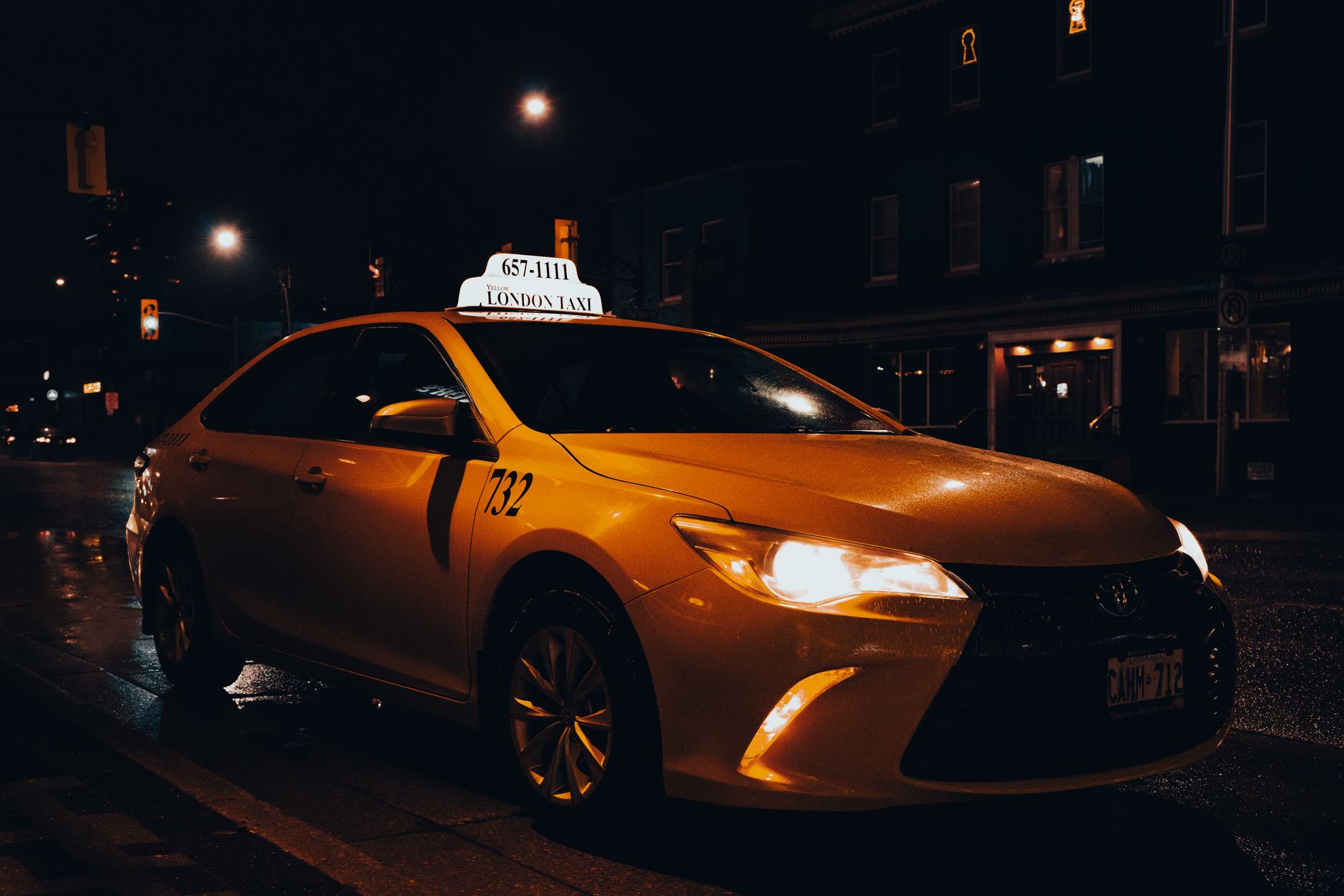
Berlin has one of the most transparent taxi tariffs in Germany. It is set by public ordinance, has been in force in this form since 20 December 2022, and no driver can adjust it: the meter is calibrated and certified, and the tariff is displayed visibly in every vehicle. What you pay is never a matter of negotiation.
Even so, most people get in without knowing what the display will say at the end. That isn’t because the tariff is complicated. It’s because two or three rules exist that you have to know about in order to use them at all. Not knowing them doesn’t mean you’re overcharged — it means you pay more than you needed to.
The tariff, as of 2026
The ride starts with a base fare of €4.30, charged the moment the meter runs. That figure already covers the first short segment.
After that it’s billed per kilometre on a tapering scale — the further you go, the cheaper each kilometre gets:
| Distance | Price per kilometre |
|---|---|
| up to 3.0 km | €2.80 |
| 3.0 to 7.0 km | €2.60 |
| beyond 7.0 km | €2.10 |
That taper is why short rides feel so expensive and long ones turn out surprisingly fair. Including the base fare, your first kilometre effectively costs over seven euros; your twentieth costs €2.10.
Three worked examples, so the orders of magnitude stick:
- 3 km — €4.30 + 3 × €2.80 = €12.70
- 7 km — €4.30 + €8.40 + 4 × €2.60 = €23.10
- 20 km — €4.30 + €8.40 + €10.40 + 13 × €2.10 = €50.40
Those are pure running costs with the traffic moving. When the taxi stops, a waiting-time component runs alongside, billed by the minute. It is set at €39.00 an hour — exactly 65 cents for every stationary minute. This is the item that wrecks every estimate at rush hour — on the Frankfurter Allee a single phase of traffic lights can cost more than the next kilometre.
The short-hop rate: €6, but only on one condition
Berlin has a short-distance rule that is genuinely good — and that most people use wrongly.
Up to 2 kilometres you pay a flat €6.00. Against the regular tariff (€4.30 + 2 × €2.80 = €9.90) that saves almost four euros on a trip you’ll have finished in ten minutes.
The catch is decisive: the short-hop rate applies only if you flag down a moving taxi in the street. It does not apply if you get in at a rank. It does not apply to phone bookings. And it does not apply if you order through an app.
Two further points. You have to ask for it as you get in — say “Kurzstrecke, bitte” and give your destination. Ask at the other end and you’ve lost the right to it, because the meter ran normally. And the two kilometres are a hard limit: go further and the standard tariff applies to the whole journey. At 2.3 kilometres you don’t pay six euros plus a little, you pay the full regular fare.
In practice: if you’re outside a hotel and want to go two stops, walk the twenty metres to the road and wave rather than taking the cab on the rank. It’s the one trick in this piece that saves money on every single short ride.
From BER a different tariff applies than to BER
This is the point almost every guide gets wrong — including my own earlier version of this article. Journeys departing from BER airport are not billed at the city tariff but under a separate Tariff Level 3.
| City (Level 2) | From BER (Level 3) | |
|---|---|---|
| Base fare | €4.30 | €4.30 |
| First kilometres | €2.80 (to 3 km) | €2.60 (to 5 km) |
| Thereafter | €2.60 / €2.10 | €2.00 beyond 5 km |
On top of that, a €1.50 surcharge applies at the BER pick-up area.
The effect runs contrary to expectation: over a long distance the airport tariff is cheaper than the city one. Thirty kilometres from BER into town works out at €4.30 + 5 × €2.60 + 25 × €2.00 = €67.30, plus the €1.50 surcharge. The same thirty kilometres on the city tariff would be €71.40. So the airport surcharge isn’t a mark-up; it sits inside a calculation that comes out slightly lower overall.
Direction is what matters: Level 3 applies from the airport, not towards it. Heading out from Mitte to BER in the morning, you’re on the ordinary city tariff. Realistically, expect €50 to €65 between the centre and BER depending on where you start and how the traffic runs.
Whether that’s worth it comes down to headcount. Travelling alone with time to spare, the airport express or the S9 costs a fraction. With two or three people and luggage the sums tip towards the taxi quickly, especially before six in the morning. Which train actually goes where, and why an AB ticket won’t get you to BER, is under Berlin BER airport transfer. The equivalent maths for other airports is under Airport Transfer.
Fixed fares: predictable, not cheaper
Since June 2024 you have been able to book journeys in Berlin at a fixed price — provided you book ahead, by phone through a dispatcher or via an app. The agreed price has to sit within a corridor of −10% to +20% around the regular metered fare.
That’s the number people skip over: a fixed price is not a guarantee of a lower fare. It is a guarantee of predictability.
It pays off in two situations. When congestion is likely — on a route that clogs at rush hour, a fixed price at the top of the corridor still beats a metered ride with twenty minutes of standing time. And when you have to expense it: for a travel claim, a figure known in advance is worth more than a few euros saved. On a long, free-flowing run, the meter and its taper win almost every time.
What costs extra — and what explicitly doesn’t
Berlin’s tariff is pleasingly short on surcharges:
- 5th to 8th passenger: a one-off supplement of €6.00. Large vehicles like this need booking ahead; they’re rarely sitting on a rank.
- Voucher or invoice settlement: €1.50.
- BER pick-up area: €1.50.
And the other side of the ledger, which matters just as much: card payment, luggage in the boot, pushchairs, wheelchairs and pets cost nothing extra in Berlin. If someone tries to add a luggage supplement at your destination, that isn’t the tariff. Bulky items that won’t fit in the boot are the one borderline case where a small per-item charge can legitimately appear.
Your right to a receipt is statutory: ask and you get one, handwritten if necessary. What that receipt has to say for it to be worth anything at tax time — and why a taxi ride is billed at seven per cent VAT rather than nineteen — is covered under what a Berlin taxi actually costs.
Taxi, ride-hailing app or the BVG
In Berlin the taxi competes with Uber, Bolt and FreeNow. The key difference isn’t price, it’s regulation: taxis have an approved fixed tariff; private-hire operators don’t.
Everything else follows from that. App prices move with demand — rain, the end of a concert, trade-fair days, New Year’s Eve. On the Mitte–BER run they often sit at €35 to €45 under normal conditions, below the taxi; when surge pricing kicks in that reverses within minutes. The taxi tariff never moves. It is the same at midday on a sunny Tuesday as at three in the morning in December.
In practice: under normal demand the apps are often slightly cheaper over medium distances. At peak load the taxi is reliably the cheaper option and usually the faster one to find — there’s nearly always one on the rank outside a station. And over short distances it wins through the short-hop rate anyway, provided you flag it down. How this plays out in other cities is under Taxi & Fares; for regular drivers and hourly bookings, see Chauffeur & Shuttle.
That leaves the BVG. A single ticket costs a fraction of any of this, and across the dense inner-city network you’re barely slower on many routes. Honestly, a taxi earns its keep in Berlin mainly when you have luggage, when there are several of you, when you’re out at night, or when you need a connection that cuts across the network rather than along it.
On tipping: rounding up to the next whole euro is normal, five to ten per cent on longer journeys. None of it is obligatory.
How this tariff stands against the app offerings I work through under Uber or taxi in Berlin.
One airport where the group ticket beats the taxi is Stuttgart; the sums are under Stuttgart Airport transfer.
How to actually get hold of a taxi, not just what it costs — dispatch centres, apps and ranks compared — is under booking a taxi in Berlin.
A city with a fixed-price system fundamentally reformed since December 2024 is Frankfurt, covered under taxi fares in Frankfurt.
How the official tariff and fixed-price routes look in another major city is covered under taxi fares in Munich.
All figures here are as of 2026. The tariff is set by ordinance and adjusted at irregular intervals, usually with notice and a public argument beforehand — but a glance at the notice inside the vehicle never hurts. Two things cover most situations: flag taxis down rather than boarding at a rank for short trips, and remember that at BER the journey home is billed under a different tariff than the journey out.
Keep reading
Cities
Booking a Taxi in Berlin: Phone, App or Rank
Booking a taxi in Berlin, 2026: dispatch numbers, FreeNow vs Taxi Deutschland, hailing vs the rank, plus wheelchair-accessible taxis and early flights to BER.
Jonas Reinhardt6 July 2026
Taxi & Fares
Taxi Fares in Germany: Why Every City Sets Its Own Price
Taxi fares in Germany: who sets the prices, how a fare is built up, and why the base fare in Berlin and Munich differs by nearly two euros.
Jonas Reinhardt14 August 2026
Cities
Taxi Frankfurt: What the Ride Costs and How Far the Service Area Reaches
Frankfurt taxi tariff 2026: a flat 4-euro base fare, 2.40 euros per kilometre, a fixed-price corridor since 2024, and a service area reaching Hanau and Wiesbaden.
Jonas Reinhardt9 July 2026
Cities
Taxi Frankfurt (Oder): 2026 Tariff and the Run to Słubice
Frankfurt (Oder) taxi tariff since July 2026: a 4.80-euro base fare, 3.05 euros to kilometre two, then 2.75 — and the run to Słubice falls outside it.
Jonas Reinhardt17 September 2026
Taxi & Fares
Taxi in Hamburg: The Cost, and Where the 9km Line Falls
Hamburg taxi fares in 2026: €4.50 base, €2.70 a kilometre and only €2.00 from kilometre nine — plus fixed prices, the minivan supplement and worked examples.
Jonas Reinhardt14 August 2026