Berlin BER Airport Transfer: FEX, S-Bahn or Taxi Into Town
BER sits 26 kilometres south-east of the centre — further out than any other major German city airport. Which is exactly why how you get into town isn't a detail here. It's a decision worth 50 euros and half an hour.

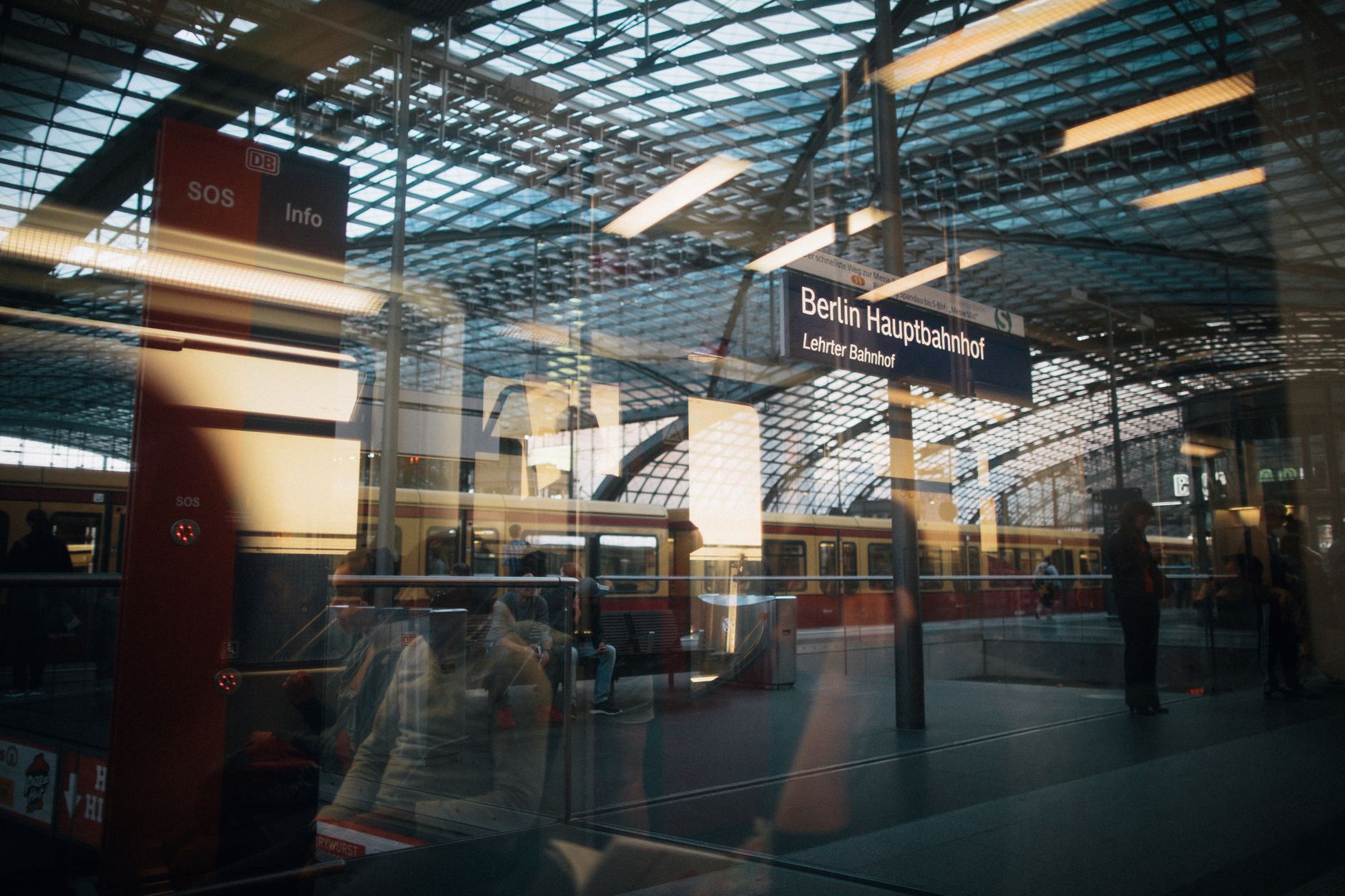
At BER, the moment you clear baggage reclaim you face a decision most German airports make for you. Hamburg has one S-Bahn line, Stuttgart has one — everywhere else you simply get on. At BER, an express train, two S-Bahn lines and four regional services all call at a station underneath Terminal 1, while outside there are taxi ranks, a dedicated zone for Uber and Bolt, and a forecourt for pre-booked drivers. Five options that differ sharply in journey time, price and effort.
The reason there are so many is distance. The station is conveniently placed right under the terminal, but the centre of Berlin is about 26 kilometres away, which a car covers in roughly 37 minutes — those figures and the meter readings that follow from them are collected under distances and indicative taxi fares from BER. Frankfurt manages the same trip in twelve kilometres, and anyone landing there who wants the city at the other end laid out properly will find it in a guide that sorts out the districts, the routes and the prices. In Berlin the distance means one thing: every wrong choice costs more here than it would elsewhere.
How do I get from BER into the centre? The short answer
Travelling light, alone or as a pair: take the train, because the price gap to a taxi is brutal. Four of you, landing late, three suitcases and a pushchair: take the taxi and don’t feel bad about it. Everything in between comes down to three questions — where exactly are you going, what time is it, and how many of you are there?
One thing that makes no difference at all: Terminal 1 or Terminal 2. Both share the same station, the same taxi ranks and the same pick-up zone. The Flughafen BER station sits directly beneath Terminal 1 on level U2; from Terminal 2 you walk out to arrivals level E0 and follow the signs, a short covered walk. If you want the wider picture of how German airport terminals, security and baggage routes are laid out, there’s an overview of terminal layouts, security lanes and baggage rules.
FEX: 23 minutes to Hauptbahnhof — but not to Alexanderplatz
The Flughafen-Express (FEX) is the fastest rail link. The airport states it runs around the clock, every 15 minutes between 4 a.m. and 1 a.m. — a frequency at which you stop consulting timetables and just walk down to the platform.
| Destination | FEX journey time |
|---|---|
| Berlin Südkreuz | approx. 14 minutes |
| Berlin Potsdamer Platz | approx. 19 minutes |
| Berlin Hauptbahnhof | approx. 23 minutes |
The catch is in what the table doesn’t say. The FEX runs via Südkreuz and Potsdamer Platz to Hauptbahnhof. Alexanderplatz, Friedrichstraße, Ostbahnhof and Warschauer Straße are not on its route. If your hotel is in Mitte east of the Brandenburg Gate, in Friedrichshain or in Prenzlauer Berg, the minutes the FEX saves you get handed straight back at the change. Those 23 minutes are only the relevant number if Hauptbahnhof, Potsdamer Platz or Südkreuz is genuinely where you’re headed.
S9, S85 and the regional trains: slower, but right
For everyone else the S-Bahn is often the better call — not because it’s quicker, but because it goes to the right places. The S9 links the airport every 20 minutes via Schöneweide, Treptower Park, Warschauer Straße, Ostbahnhof, Alexanderplatz, Hackescher Markt, Friedrichstraße and Hauptbahnhof, carrying on to Spandau: the whole string of inner-city stations, with no change at all. Since the timetable change on 14 December 2025 the S85 has joined it, also every 20 minutes, running via Adlershof to Ostkreuz and onwards around the eastern ring — to Wittenau and Frohnau on weekdays, to Pankow at weekends. Between them the two produce something close to a ten-minute frequency on the shared stretch.
Honestly about the journey time: the S9 calls at a good dozen stations and is noticeably slower than the FEX. Exactly how much slower depends on your destination, and the only reliable source is the timetable on the day. What you get in exchange for those minutes is concrete, though — stepping off at the right station, rather than wrestling suitcases onto the U5 at Hauptbahnhof.
And a correction, because plenty of guidebooks still have it wrong: the RE7 no longer serves BER. What calls instead, each hourly, is the RE20 (Hauptbahnhof – Potsdamer Platz – Südkreuz – BER – Cottbus, roughly between 4 a.m. and 9 p.m.), the RB22 towards Potsdam and Friedrichstraße, the RB24 via Ostkreuz to Eberswalde and the RB32 via Ostkreuz to Oranienburg. For passengers heading into town, RB24 and RB32 matter mainly as a link to Ostkreuz — from there the ring and cross-city lines reach almost anywhere without going near Hauptbahnhof. And if an RE20 is listed ahead of the next FEX, take it: it serves the same stations.
Fare zone C: why an AB ticket isn’t enough
This is where most passengers at BER come unstuck. The airport lies in fare zone C, not in Berlin AB. An ordinary AB ticket, the one that takes you everywhere in the city proper, is not valid for the journey to or from the airport. You need Berlin ABC.
These prices have applied since 1 January 2026:
| Ticket | Price |
|---|---|
| Single, Berlin ABC | €5.00 |
| Single, Berlin AB | €4.00 |
| 24-hour ticket, Berlin ABC | €12.90 |
| 24-hour ticket, Berlin AB | €11.20 |
| Short trip (Kurzstrecke) | €2.80 |
So the zone C premium is exactly one euro per single journey. The annoyance isn’t the euro, it’s being checked with the wrong ticket. FEX, RE20, the RB services, S9 and S85 are priced identically, and there is no airport supplement on the rail side. If you hold a Deutschlandticket (€63 a month since January 2026, €43 at the reduced rate) you need to buy nothing extra at all. Paper tickets from a machine must be validated before you board; app tickets don’t need it. And if you were counting on a 7-day pass, VBB no longer sells them after the fare revision, nor the annual passes — for a long weekend, the 24-hour ticket or the Deutschlandticket are what’s left.
BER airport transfer by taxi: tariff band 3 and €1.50
The North and South taxi ranks are in front of Terminal 1 on arrivals level E0, directly outside the door; departing passengers are dropped one level up on E1. Terminal 2 has no taxi forecourt of its own — from there you take the signposted walkway between the terminals.
On price, journeys from BER run not on the Berlin city tariff but on a separate tariff band 3: a €4.30 base charge, €2.60 per kilometre up to 5 km, then €2.00 per kilometre, plus a €1.50 surcharge for boarding at the airport’s barrier-controlled taxi lane. The full tariff table, with the city bands, waiting time and the special rules, is under what a taxi ride in Berlin costs.
What that means for the airport run is surprising. For the 26 kilometres into the centre you get €4.30 + 5 × €2.60 + 21 × €2.00 = €59.30, so €60.80 with the surcharge. The same journey the other way runs on the city tariff: €4.30 + 3 × €2.80 + 4 × €2.60 + 19 × €2.10 = €63.00. The ride from the airport is cheaper than the ride to it. That €1.50 isn’t a mark-up on an identical bill; it’s part of a different and, overall, slightly lower one.
What blows those figures apart is standing still. Waiting time runs at €39.00 an hour — 65 cents a minute, and on the A113 at rush hour that’s the item that eats every estimate. At the rank, staff from the airport’s service operator APCOA will arrange a wheelchair-accessible vehicle, a child seat or a larger car on request. And a warning the airport issues itself: board only at the official ranks. Anyone who approaches you inside the terminal is not a taxi.
Fixed prices work to BER — but not from BER
This is the rule most guides write straight past. Since 1 July 2024, a fixed price may be agreed in Berlin if the journey is pre-booked, by phone or through an app, and the price has to sit inside a corridor of −10% to +20% around the regular meter fare.
That corridor covers journeys within Berlin and from Berlin to BER. It does not cover journeys from the airport: BER is in Brandenburg, in the district of Dahme-Spreewald, and the Berlin fixed-price rules stop at the state line. So at the airport rank there is no negotiable fixed price — the meter runs, and only the meter.
In practice: pre-booking pays off for the outbound trip to your flight, not for the ride into town. On a €63.00 meter fare the corridor works out at €56.70 at the bottom and €75.60 at the top; to check what −10% and +20% do to your own figure, a straightforward percentage calculator beats mental arithmetic at the terminal. A fixed price isn’t a saving anyway — it’s a planning guarantee. If you have to leave at 5 a.m. for a 7.30 departure, a fixed sum at the top of the corridor still beats twenty minutes of waiting time on the clock. How you place that booking is covered under booking a taxi in Berlin.
Uber, Bolt and FreeNow: the ride-app zone on E0
BER has set up a dedicated Ride App Pick up zone on arrivals level E0, on the forecourt in front of Terminal 1, covering Uber, Bolt and FreeNow. It solved a genuine problem: before it existed, drivers and passengers met somewhere along 400 metres of kerbside.
One regulatory difference remains, and it decides how long you wait: private-hire drivers may not wait for custom at BER. They are only allowed onto the site once a ride has been booked in the app. A taxi is standing at the rank as you walk out; an Uber is only setting off at that moment — a few minutes under normal conditions, noticeably longer after several aircraft land together, which is usually precisely when surge pricing kicks in too. What that means legally is under Uber or taxi in Berlin.
A private Berlin airport transfer: chauffeur instead of meter
A pre-booked private transfer is the third road option. The driver waits in arrivals with a name board, usually tracks your flight and shifts the pick-up time automatically if you’re delayed. Legally this is a private hire vehicle with driver, not a taxi, so no official tariff applies — the price normally sits above the meter, but it is fixed in advance and knows nothing of corridors, state lines or waiting-time clocks. What sets the two apart is under chauffeur service: when it pays. At BER that carries an advantage airports close to their city centres don’t offer: over 26 kilometres the gap to the meter is calculable and narrow, while the risk of a jammed A113 is large.
If you’re driving to BER yourself, or being collected, know the parking rates first — the individual car park tariffs, the free kiss-and-ride minutes and the difference between terminal-side and outlying options are worked through under what parking at BER actually costs. Being picked up only beats paying for a taxi if the person collecting you isn’t sitting for half an hour in the priciest multi-storey.
Night-time at BER: what runs between 1 and 4 a.m.
BER has no blanket night flight ban, so aircraft land at hours when the 15-minute frequency has long since ended. What’s still available:
- The FEX runs around the clock according to the airport, but the dense frequency only between 4 a.m. and 1 a.m. In between the connection exists while the gaps grow — check the timetable rather than heading down on spec.
- The S9 runs right through on Friday/Saturday and Saturday/Sunday nights, every 30 minutes, plugging into Berlin’s night network. That does not apply midweek.
- Night bus N7 links the airport continuously with U Rudow on the U7, supplemented by the N7X and N36 — dependable, at the cost of a change.
- The taxi rank is staffed around the clock. The Berlin tariff has no night surcharge; the fare at 3 a.m. is the fare at 3 p.m.
By day the express buses join in: the X7 every 5 to 10 minutes to U Rudow and the X71, both from level E0. If you’re heading for Potsdam there’s the BER2 AirportShuttle via Teltow, Stahnsdorf and Kleinmachnow — though that one carries a surcharge on top of the VBB fare or the Deutschlandticket, paid as you board. It is the only service at BER where your ticket alone isn’t enough.
Worked example, and which option suits you
You land on a Wednesday at 23:10 with a suitcase each and want a hotel at Alexanderplatz. On the S9 you ride to the door with no change and pay two ABC singles at €5.00 — €10.00 between you, with trains still running every 20 minutes at that hour. On the FEX you’d be at Hauptbahnhof in 23 minutes, then changing onto an S-Bahn or tram with two suitcases. By taxi you’d pay roughly €60.80 under tariff band 3, with no walk at either end, and with the A113 clear at that hour you’d barely exceed the 37 minutes quoted above. The premium over the train: a little over €25 a head.
What flips the maths is the number of passengers, not the hour. For two, the taxi costs six times the train; for four, with €20.00 of rail tickets, only three times as much — and if everyone has two bags, that difference is worth paying. The whole decision follows from that:
- Heading for Hauptbahnhof, Potsdamer Platz or Südkreuz: the FEX. 23 minutes, every 15 minutes, €5.00.
- Heading for Alexanderplatz, Friedrichstraße, Ostbahnhof or Friedrichshain: the S9, even though it’s slower. A change avoided with luggage beats ten minutes saved.
- Heading for Ostkreuz, the eastern ring or Prenzlauer Berg: the S85, or the RB24 and RB32 regional services.
- Three or more of you with luggage: the taxi. The fare is per journey, not per head.
- Outbound to a flight on a tight schedule: a pre-booked taxi at a fixed price — the corridor exists in that direction, and not in the other.
- Arriving between 1 and 4 a.m. midweek: taxi or pre-booked transfer; the S9 only runs through at weekends.
All figures and frequencies here are as of 2026. VBB fares are revised at the turn of the year, the Berlin taxi tariff by ordinance, and whether the fixed-price rules ever extend to journeys from BER depends on talks between Berlin, the airport company and the district of Dahme-Spreewald — a quick check before you travel never hurts. Two things won’t change in the meantime: the ticket has to be ABC, not AB. And the fastest train isn’t automatically the right one if it finishes at the wrong station. More cities and their airport links are under Airport Transfer.
Keep reading
Airport Transfer
Leipzig/Halle Airport Transfer: S-Bahn, Night Bus or Taxi to Either City
From Leipzig/Halle Airport into Leipzig and into Halle in 2026: €6.90 on the S5/S5X in either direction, the NXL night bus, an Intercity every two hours and a 2022 taxi tariff that still applies at the airport – with worked fares.
Jonas Reinhardt25 September 2026
Airport Transfer
Barcelona Airport Transfer: Aerobús, Metro, R2 or Taxi – T1 or T2?
Barcelona-El Prat into the city in 2026: Aerobús for €7.75, metro L9 Sud with a €5.90 airport ticket, the R2 Nord train from T2 only, and taxis with a €4.60 airport supplement and €21 minimum – and why your terminal decides every option.
Jonas Reinhardt25 September 2026
Airport Transfer
Cologne Bonn Airport Transfer: S19, SB60 or Taxi – What Each City Costs
From Cologne Bonn Airport into town in 2026: €4 by S-Bahn to Cologne, €10.50 on the SB60 express bus to Bonn, roughly €51 to €57 by taxi to Cologne and around €80 to Bonn – and why the Bonn route changes in December 2026.
Jonas Reinhardt25 September 2026
Airport Transfer
Munich Airport Transfer: S1, S8, the Lufthansa Bus or a €96 Taxi
Munich Airport to the city in 2026: S-Bahn from €15.10 (less with a stripe ticket), Lufthansa Express Bus from €12.50, a €96 fixed taxi fare to the main station – and what makes sense for one, two or four people.
Jonas Reinhardt25 September 2026
Airport Transfer
Airport Transfer Hamburg: S1, Taxi or Private Car to HAM
Hamburg Airport into the city in 2026: the S1 in 25 minutes to Hauptbahnhof, taxis from around 30 euros, night bus 606, and when a private transfer is worth it.
Jonas Reinhardt19 August 2026