What a Berlin Taxi Actually Costs — and What You Get Back
The number on the meter is rarely the number the journey costs you. In between sit the waiting-time clock, the fixed-price corridor, the VAT rate and a receipt that either works or does not.

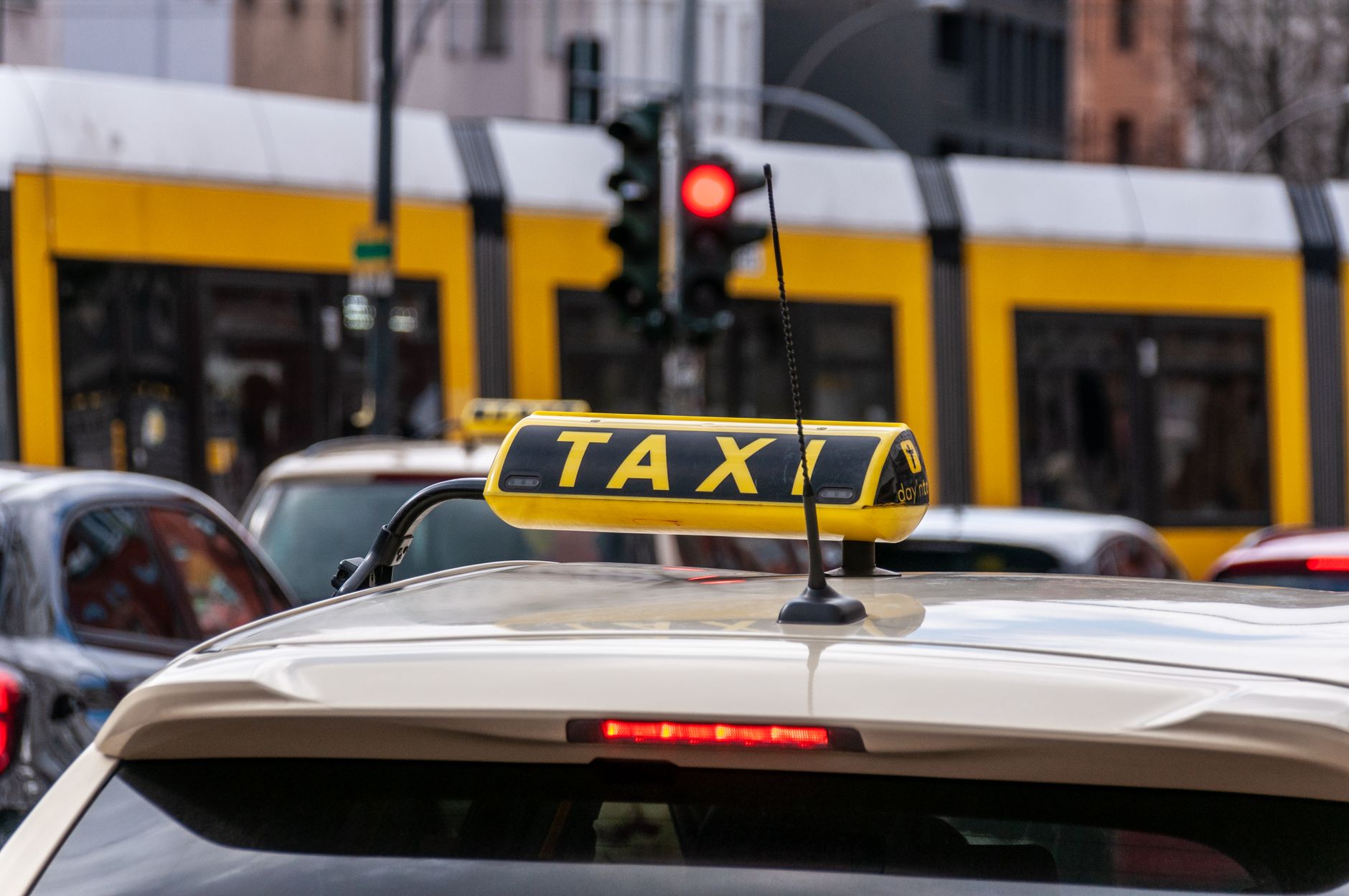
€63.00. That is, to the cent, what the meter reads for the run from the Kurfürstendamm out to BER — 26 kilometres on Berlin’s ordinary city tariff. The state of Berlin’s own guidance quotes roughly €63 for that journey, and if you work the tariff out yourself you land on exactly the same figure. Berlin is pleasantly honest that way.
What happens either side of that number is the interesting part. Because what a Berlin taxi journey actually costs you is almost never what the display says. On one trip, twelve minutes of standing still get added that nobody budgeted for. On another you buy your way out of exactly that risk with a fixed price, and pay a premium for the privilege. And if you’re travelling on business, some of the money comes back afterwards — but only if the receipt carries the right four details.
The tariff itself is deliberately not the subject here; the full table with the short-hop rate and the surcharges is under what a Berlin taxi ride costs. This piece is about the money around it.
What does a taxi in Berlin cost? Four routes, four figures
To get the orders of magnitude straight, here are four journeys people genuinely make, on the city tariff (as of 2026: €4.30 base, then €2.80/km to 3 km, €2.60/km to 7 km, €2.10/km beyond):
| Journey | Distance | Meter |
|---|---|---|
| Short hop, flagged down | up to 2 km | €6.00 |
| The same 2 km taken from a rank | 2 km | €9.90 |
| Hauptbahnhof to Prenzlauer Berg | approx. 5 km | €17.90 |
| Mitte to Steglitz | approx. 10 km | €29.40 |
| Kurfürstendamm to BER | approx. 26 km | €63.00 |
That second row is the most expensive routine mistake in Berlin. The same two kilometres cost either €6.00 or €9.90 depending purely on whether you got in at a rank or waved down a moving cab in the street — €3.90 apart, close to forty per cent, for an identical service. Which booking method has which consequences is set out under booking a taxi in Berlin; for the cost side, one rule covers it: short trip, stick your arm out.
Berlin taxi prices per kilometre — the figure almost everyone misuses
“Cost per km” is one of the most-searched framings of this question, and it misleads people systematically. There is no per-kilometre price in Berlin. There are three, they fall as the journey lengthens, and a base fare sits on top of all of them, spread across however far you go.
What actually matters is the average across your specific trip. Take the figures above and divide:
- 1 km → €7.10 total → €7.10 per kilometre
- 5 km → €17.90 → €3.58 per kilometre
- 10 km → €29.40 → €2.94 per kilometre
- 26 km → €63.00 → €2.42 per kilometre
The effective rate falls to roughly a third of where it started. So anyone estimating a Berlin fare at “about €2.50 a kilometre” is only right beyond about twenty kilometres. At five kilometres that rule of thumb undershoots by a third. For the opposite end of the scale — long runs out past the city boundary — I’ve worked the same maths through four cities under what a 50-kilometre taxi ride costs.
If you’d rather not do that division in your head, I use a set of small calculators that show their working rather than just firing back an answer. No ads, no cookies, no third-party scripts — which ought to be the baseline for a pocket calculator and sadly isn’t.
The line item that wrecks every estimate: standing still costs 65 cents a minute
Every figure above assumes the traffic is moving. The moment the taxi stops, Berlin’s waiting-time clock starts, and it is set at €39.00 an hour (as of 2026). That is exactly 65 cents a minute — and it runs not only when you keep the driver waiting but in ordinary congestion and at every set of lights where nothing shifts.
Put a number on it. Your ten-kilometre run from Mitte down to Steglitz is €29.40 with the traffic flowing. Twelve minutes stationary on the Potsdamer Straße turns that into €37.20. That’s a quarter added on top, and no per-kilometre rule of thumb anywhere will predict it.
Which is why the honest answer to “what will this cost?” in Berlin is always a range, and why the time of day matters nearly as much as the distance. The identical route at 8.15 in the morning and at 10.15 at night are two different amounts of money, even though the tariff has not moved a cent.
Berlin airport taxi costs: the outbound and the return are two different sums
BER does not sit inside Berlin. It’s in Schönefeld, over the boundary in Brandenburg, roughly 26 kilometres from the centre. For your wallet that means two different tariff levels apply depending on which way you’re pointed.
Going to BER, you’re on the ordinary city tariff. Twenty-six kilometres is the €63.00 calculated above; from further east, say Alexanderplatz, the state’s own figure is around €58.
Coming from BER, a separate tariff level applies: €4.30 base, €2.60/km for the first 5 kilometres, then €2.00/km. The same 26 kilometres therefore come to €59.30, plus a €1.50 charge for entering the airport pick-up area — €60.80 all in. The return leg is about €2.20 cheaper than the outbound one, airport surcharge included. It isn’t much money, but it is the opposite of what nearly everyone assumes.
If your destination is somewhere other than “the centre”, it’s worth checking the road distance and an indicative fare from BER to the actual address — 26 kilometres and a little under forty minutes is the figure for Mitte, while Potsdam is around fifty. And if the harder problem is finding the rank in the first place, how BER’s terminals connect and where the taxis wait is documented far better over at the airport guide than it could be in a piece about prices.
A fixed price is insurance against the traffic, not a discount
Since 2024 you’ve been able to book pre-ordered journeys in Berlin at a fixed price. The agreed sum may deviate from the regular metered fare by at most 20 per cent upwards and 10 per cent downwards. On our €63.00 run, that puts the permitted corridor at €56.70 to €75.60 — a spread of nearly nineteen euros for the very same journey.
How the reference price is built is the part that matters: it comes from the route as calculated by routing software, priced at the regular tariff’s per-kilometre rates. Waiting time is not in it. That is the whole deal in one sentence — a fixed price isn’t a discount, it’s insurance against the 65 cents a minute. On a route that reliably clogs at rush hour it’s frequently the cheaper option even at the top of the corridor. On a clear road at eleven at night, you’re paying over the odds.
Whether a quoted fixed price even sits inside the permitted band is a ten-second sum; you can work the corridor out around any metered figure before you accept it. One caveat: when the rules came in, journeys from BER into Berlin were explicitly excluded. Whether that has since been widened I could not properly verify — so ask when you book rather than trusting a year number.
The receipt: seven per cent, not nineteen
This is where it gets concrete for business travellers. A taxi ride in Germany carries the reduced VAT rate of 7 per cent, not the usual 19. The basis is § 12 (2) no. 10 of the German VAT Act: the reduced rate applies to passenger transport by taxi either within a single municipality, or where the journey does not exceed 50 kilometres.
For Berlin that works out neatly. Any journey inside the city is covered by the first limb. The run to BER does cross the city boundary, but at 26 kilometres it sits well inside the 50-kilometre limit and is caught by the second. Only on genuinely long cross-country runs — out towards Cottbus, say — does the calculation tip over.
The difference is not a rounding error. On €63.00 gross, the VAT contained at 7 per cent is €4.12 and the net is €58.88. Anyone who reflexively applies 19 per cent claims €10.06 of input tax and over-recovers by nearly six euros. That’s precisely the sort of thing an audit picks up, and separating a gross figure into net and tax at seven per cent takes less time than arguing about it afterwards.
For the receipt to support an input-tax claim at all, it has to contain something. Up to €250 gross it counts as a simplified invoice under § 33 UStDV, and four details suffice: the taxi operator’s full name and address, the nature and extent of the service, the date, and the gross amount with the tax rate stated. That last one is where it falls apart — a slip with no “7 %” on it is worthless for tax. Your right to a receipt is absolute; ask for one before you get out, handwritten if it comes to that. If you settle through an account or invoice arrangement, Berlin’s tariff adds €1.50 for the privilege.
Corporate customers usually get a consolidated monthly invoice from a Berlin dispatcher, and that arrives with ordinary payment terms attached. On a monthly invoice of €1,240, two per cent for settling within ten days is €24.80 — and what an early-payment discount is actually worth is worth establishing before the window closes rather than after.
One aside: Uber and Bolt operate in Germany as private hire, not as taxis, and the reduced rate names taxi traffic specifically. What else follows from that distinction is under Uber or taxi in Berlin.
Tips appear on no receipt
Rounding up to the next whole euro is the Berlin norm, five to ten per cent on longer runs. None of it is obligatory, and from a cost perspective one thing matters most: a voluntary tip carries no VAT. There’s no input tax to reclaim on it, and it won’t appear on the receipt, because the driver never puts it through the till.
For an expense claim that makes a tip an incidental travel cost your employer can reimburse, but only against some form of evidence. Since nobody issues a receipt for two euros, a self-certified voucher is the normal route — a short note with the date, the route, the amount and the reason. At a sensible level that gets accepted; round up by forty per cent and you’ll deserve the questions you get.
When the sums go against the taxi
I’m happy to take taxis in Berlin, but it’s only honest to name the cases where the arithmetic clearly loses. Travelling alone without heavy bags, the BVG network across the inner city costs a fraction and is rarely meaningfully slower. Heading to BER on your own, the S9 or the FEX wins nearly every time unless you’re genuinely against the clock.
And if you’d otherwise be driving your own car for a multi-day trip: two taxi runs to BER and back are about €124. That’s a figure you can hold against what an airport parking space costs per day — over a week it goes either way depending on the car park, over three days it almost always favours the taxi.
For context, since Berlin gets a reputation it hasn’t earned: by German standards it is not an expensive city to take taxis in. Every municipality sets its own tariff, and Berlin sits in the lower half of the range. And if your next trip is Frankfurt, the sums change anyway — the airport there is only about twelve kilometres out and the city is compact enough that a taxi is frequently the wrong call; getting your bearings in Frankfurt is better handled over there than in a fares article.
One last thing about 2026, because it gets muddled. Berlin’s taxi tariff itself has not changed since 20 December 2022. The 2.2 per cent increase that went round the press for 1 January 2026 applied to the fees the Taxi Berlin dispatching centre charges its affiliated operators — not to the fare you pay. That only moves when the Senate issues a new ordinance, and when it does, it isn’t quiet about it.
Three sentences will get you through Berlin. Flag one down rather than boarding at a rank for anything short. Take the fixed price when the route is prone to jamming, because the waiting clock costs more than the premium. And ask for the receipt with “7 %” printed on it before you shut the door — otherwise you’ve paid for the ride and paid for it twice over.
Keep reading

Taxi & Fares
Taxi Cologne: What a Ride Costs and Why the Tariff Reaches Düsseldorf
Cologne taxi fares 2026: a €4.90 base fare, a flat €2.90 per kilometre, 60 cents a minute waiting – with worked fares to the trade fair, Cologne Bonn Airport and the rise already set for March 2027.
Jonas Reinhardt25 September 2026
Taxi & Fares
Taxi Düsseldorf: What a Ride Costs and Where the €25 Fixed Fare Applies
Düsseldorf taxi fares 2026: a €5 base fare, €2.70 per kilometre, €43 an hour waiting, a €2 airport supplement and a fixed price between the airport and the trade fair – with worked fares across the city.
Jonas Reinhardt25 September 2026
Taxi & Fares
Uber Prices in Germany: Base Fare, Per-Kilometre Rate, Minimum Fare
What UberX actually costs in Germany in 2026: base fare and per-kilometre rate in Berlin, Hamburg and Munich compared, surge pricing explained, and when the taxi tariff wins.
Jonas Reinhardt15 August 2026
Taxi & Fares
Bolt Prices in Germany: How the Upfront Fare Is Actually Built
Bolt publishes no fare table for Germany. What goes into the price instead: pickup fee, per-minute and per-kilometre rates, dynamic pricing, cancellation rules — and why Munich has imposed minimum fares since July 2026.
Jonas Reinhardt17 September 2026
Taxi & Fares
Taxi Hanover: What the Ride Costs and Why One Tariff Reaches Past the City Limits
Hanover taxi tariff 2026: €4.50 base fare, €2.80 per kilometre, €35 an hour waiting, no night surcharge – and fixed prices bookable by app since September 2025.
Jonas Reinhardt5 August 2026