Taxi Frankfurt (Oder): 2026 Tariff and the Run to Słubice
This is Frankfurt an der Oder in Brandenburg, not the banking city on the Main. The town got a new taxi tariff on 1 July 2026, and it has a quirk no other German city shares: its mandatory service area ends in the middle of a bridge.

First things first, because search engines reliably dump people here who wanted something else entirely: this is Frankfurt an der Oder in Brandenburg, right on the Polish border — not Frankfurt am Main with the skyline and the huge airport. If it’s the banking city you’re after, its tariff and fixed-price corridor are set out under Taxi Frankfurt, and the Frankfurt am Main city guide works the everyday numbers through under what a taxi actually costs on the Main.
Still here? Good. Because the Oder town offers something no other German taxi city does in quite this form: a tariff boundary that sits on a bridge, and beyond it a country whose pricing law is built the other way round.
The Frankfurt (Oder) Tariff, as of 2026
The governing text is the Taxitarifverordnung 2026, passed by the city council on 21 May 2026, published in the city’s official gazette No. 4 of 10 June 2026, and in force since 1 July 2026. It replaced the 2024 ordinance.
| Component | Price |
|---|---|
| Base fare | €4.80 |
| Per kilometre, up to 2 km | €3.05/km |
| Per kilometre, from 2 km | €2.75/km |
| Waiting time | €0.60 per completed minute |
| Surcharge, fifth to eighth passenger | €2.00 per head |
The meter ticks in ten-cent increments. Sixty cents a minute of waiting time works out at €36 an hour, and waiting time isn’t only the stop you asked for — it also covers any standstill caused by traffic or weather, so a queue on Karl-Marx-Straße runs on the clock. Your driver is not obliged to wait longer than 30 minutes, though.
Two sentences in the ordinance are worth committing to memory. First: the fares are fixed charges that “may be neither exceeded nor undercut” — a discount is as impermissible as a markup, and offering or demanding any other figure is a regulatory offence carrying a fine of up to €10,000. Second, § 4: order a taxi and then fail to use it and you owe twice the base fare, currently €9.60, plus any waiting time already clocked up.
Frankfurt an der Oder Taxi Costs in Numbers — and the Error Almost Every Calculator Makes
Because the first two kilometres cost more than the rest, every fare works out the same way: €4.80, plus €6.10 for the first two kilometres, plus €2.75 for each kilometre after that.
| Distance | old tariff (to 30 June 2026) | since 1 July 2026 |
|---|---|---|
| 2 km | €9.40 | €10.90 |
| 5 km | €16.60 | €19.15 |
| 10 km | €28.60 | €32.90 |
| 15 km | €40.60 | €46.65 |
All on a clear run with no waiting time. The jump is roughly 15 per cent: the base fare went from €4.00 to €4.80, the long-distance rate from €2.40 to €2.75.
And now the point where almost every taxi-fare website covering Frankfurt (Oder) gets it wrong. Several calculators still quote a base fare of €5.20. That figure genuinely existed — for 31 days. The third amending ordinance of December 2023 topped the then base fare of €3.20 up with a €2.00 surcharge, explicitly time-limited to 31 January 2024, as a bridge until the new tariff with its €4.00 base fare took effect on 1 February 2024. Anyone still presenting €5.20 as current has preserved a stopgap from January 2024 and slept through two tariff rounds since. Municipal tariffs going stale like this and then being copied around for years isn’t a Frankfurt peculiarity — the mechanics behind it are set out under taxi fares in Germany.
Taxis at Frankfurt (Oder) Station
The station sits southwest of the centre, and practically every arrival from elsewhere ends here: the RE1 from Berlin, the regional services into the surrounding area, and the trains heading for Poznań. The rank is on the station forecourt.
The distances are short, and that is what defines this tariff. From the station to the Stadtbrücke is a shade under two road kilometres, about five minutes’ drive — so roughly €11 on the meter. The centre around the market square and town hall is closer still. In a town this compact, nearly every journey falls entirely inside the expensive first two kilometres at €3.05 a kilometre; the cheaper rate from kilometre three rarely comes into play. The average cost of a two-kilometre ride therefore lands at €5.45 per kilometre. That’s not an accusation of gouging, it’s simply the arithmetic of a high-base-fare tariff in a small town: short hops subsidise nothing here.
You can book through the Funktaxi Verein Frankfurt (Oder) on 0335 53 1111, around the clock. Inside the city boundary the duty to carry applies, the tariff is binding, and a calibrated meter has to be running — without a working meter a journey inside the mandatory area may not be started at all.
Taxi to Słubice: Where the German Tariff Stops
Here’s where it gets interesting. § 1 of the ordinance defines the tariff’s reach in a single sentence: the mandatory service area “comprises the territory of the city of Frankfurt (Oder)”. No surrounding municipalities, no transport association, no exception. The city boundary is the tariff boundary — and to the east, the city boundary is the national border.
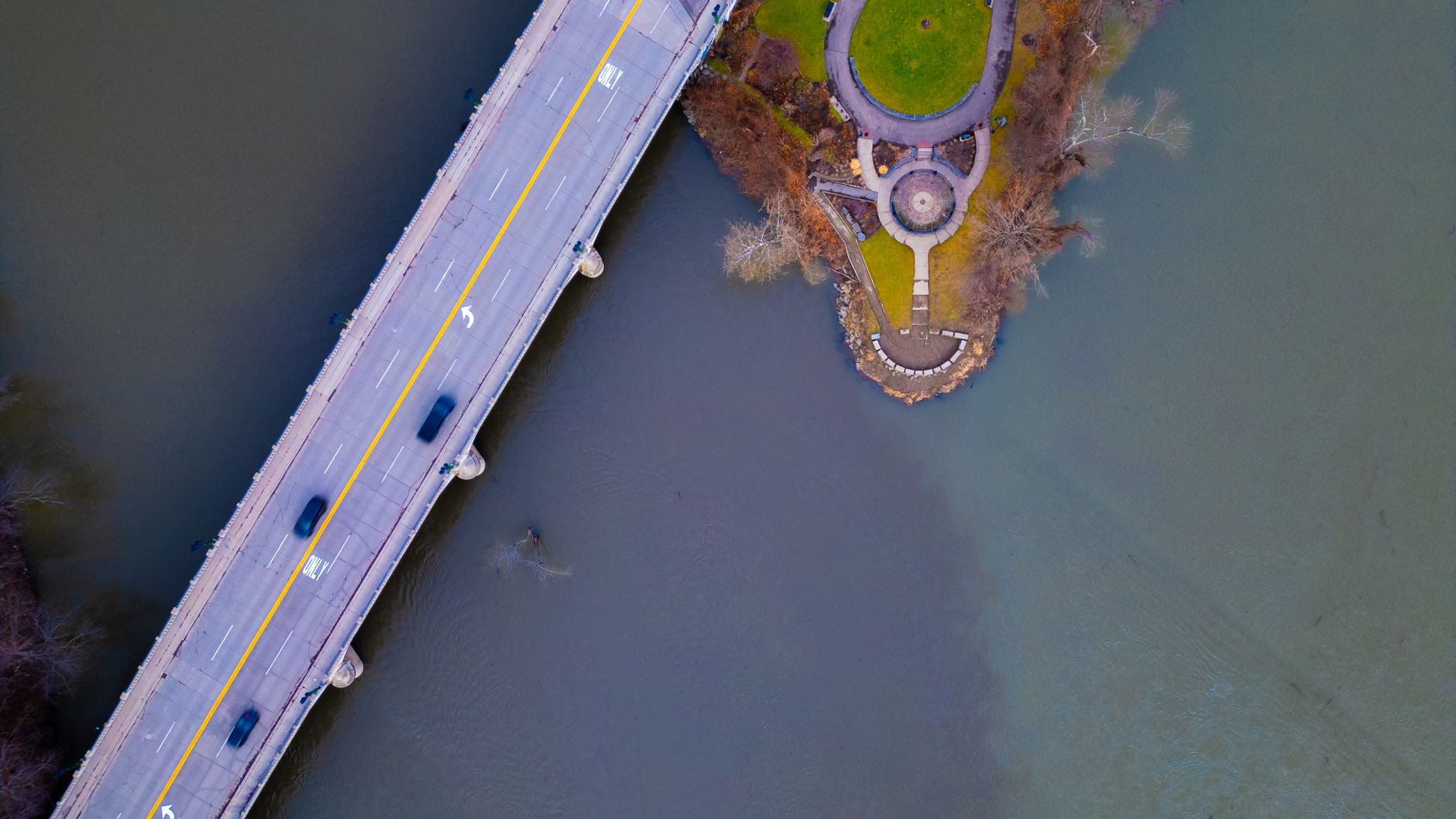
That border runs down the middle of the Oder, specifically down the centre of the shipping channel. The Stadtbrücke is 251.75 metres long and 15.2 metres wide, carries the federal road B 5 and, on the Polish side, national routes 29 and 31; it was rebuilt from scratch between late 2000 and late 2002 for €10.5 million, with 2.8-metre footways on both sides. Around 70 per cent of the structure sits on Polish territory. In practice: about a third of the way across the bridge, the German taxi tariff runs out — on the bridge, not at the bank.
What follows from that is spelled out in § 1(2), and it’s blunter than most people expect. For journeys beyond the mandatory area, the driver must tell you before you set off that the fare is freely negotiable for the entire route. Not pro rata, not from the midpoint of the bridge onward — for the whole ride, from your front door. If no agreement is reached, the tariff rates count as agreed by default.
So the question of whose meter applies over the Oder has an unromantic answer: neither. There is no German tariff past the middle of the bridge and no hybrid German-Polish rate; there is only a negotiated price. The local Funktaxi operator puts it on its own tariff page more plainly than you usually see it written: trips beyond the boundaries of the mandatory area, “such as to Müllrose (LOS), Lebus (MOL) or market runs to neighbouring Slubice”, fall outside the tariff obligation and are to be discussed with the driver on the spot — and there is no duty to carry. That squares with § 47(4) of the Passenger Transport Act, under which the duty to carry applies only inside the mandatory area. A refusal on the corner of Karl-Marx-Straße isn’t poor service; it’s permitted.
For those two and a half kilometres, then: get the price named before you get in, and repeat it out loud. On the meter it would be about €12 — a useful opening position, but not a legal entitlement.
Who May Pick Up on Which Side
The second half of the question: can the Polish taxi waiting at the Postój Taxi rank just beyond the bridge simply collect you in Frankfurt? No — not lawfully as a taxi journey, at any rate. Carrying passengers for reward in Germany requires a German permit under the Passenger Transport Act, and a vehicle licensed in Słubice doesn’t hold one. Poland applies the mirror-image principle: under its road transport act a taxi licence is granted for the territory of one municipality, with narrowly drawn exceptions for the return leg and for orders that come in from outside the area.
Even within Germany the rule is tighter than most people assume. Under § 47(2) of the Passenger Transport Act, taxis may be “held ready only at officially approved places and in the municipality in which the operator has its business seat”. So a Frankfurt taxi may take you to Słubice, but it may not join the rank there and wait for a fare back.
On top of that sits a tax obstacle that the German trade magazine taxi heute has reported on at the comparable Görlitz/Zgorzelec crossing: the portion of a journey driven in Poland has to be accounted for there for VAT purposes, which according to the local taxi association means a Polish tax number, a second calibrated meter and ongoing filings — overheads an occasional short hop across the bridge simply can’t carry. I could not verify a publication date for that report, so I pass it on as what it is: the trade’s own account, not statutory wording. It does explain neatly why cross-border runs here stay a matter of negotiation rather than becoming routine.
Paying: Euros, Złoty and a Rate With a Date on It
Poland uses the złoty, and its pricing law is built on an entirely different principle from Germany’s. Article 11b of the Polish road transport act permits a municipal council to set prices for taxi journeys within the municipality — it does not require it. And Article 11c makes clear that any such rates are maximum rates. That is the exact inverse of the German fixed charge: in Germany undercutting is prohibited, in Poland it is expressly allowed.
Whether the municipality of Słubice has used that power, I could not establish. I found no such resolution in the Lubusz Voivodeship gazette or the municipality’s public information bulletin; that is not proof that none exists. So the only reliable route is the one Polish law prescribes anyway: the tariff must be displayed visibly on the vehicle and must match the calibrated taksometr. Read it before you get in.
I’m deliberately not quoting a złoty fare here — I don’t have one from a source I’d stand behind, and an invented benchmark would be worse than none. What I can quote is the conversion: on 17 September 2026 the European Central Bank reference rate stood at €1 = 4.3580 złoty. Fifty złoty is therefore about €11.50. Run that ratio roughly in your head before agreeing to a number, and ask up front whether cards are accepted.
When the Taxi Is Worth It — and When the 983 Is
For the border crossing itself there’s an alternative that’s hard to beat. Bus route 983, run by the Frankfurt (Oder) municipal transport company, has crossed the Stadtbrücke to Słubice since 9 December 2012, calling at the Collegium Polonicum and the bus station among other stops. For fare purposes Słubice sits in fare zone B of Frankfurt (Oder) — so any ordinary VBB ticket for Frankfurt (Oder) AB covers it, and according to VBB the Deutschlandticket is valid on the 983 across the national border too. A taxi for that same stretch versus a ticket you’re already holding: rarely a hard call, unless you’ve got luggage, it’s late, or there are three of you.
One thing to factor in at the border regardless: Poland has been checking its frontier with Germany since 7 July 2025, and those checks have been extended repeatedly, most recently announced through to the end of March 2027; controls run on the German side as well. The queues form mainly at the motorway crossings — the A12 in the case of Frankfurt (Oder) — rather than necessarily at the city-centre Stadtbrücke. Keep your passport or ID card to hand anyway, even for two kilometres.
And for the long haul: the nearest major airport is BER, some 82 road kilometres away, just under an hour’s drive. On the Frankfurt meter that would theoretically come to around €230 — theoretically, because the journey left the mandatory area long ago and is therefore freely agreed in any case. Take the RE1 to Berlin and change to the airport express; how those connections work in practice is set out under Berlin airport transfer, and what a taxi costs in Berlin itself under Berlin taxi fares. If you want a sense of distances and drive times first, Routefare’s routes out of Berlin lists them clearly. At the airport itself, the BER arrivals walkthrough covers the route from gate to platform, and if someone is driving you there and leaving the car, the parking options at BER are broken down with prices.
All figures reflect 2026. The German half of this calculation is as solid as a municipal ordinance gets: published, binding, dated. The Polish half isn’t, and that’s not sloppy research — it’s because Poland deliberately left pricing there more open. Two numbers cover the German side: €4.80 base fare, €3.05 for the first kilometre. For the other side of the bridge no number will do, only a habit: ask first.
Keep reading
Cities
Taxi Frankfurt: What the Ride Costs and How Far the Service Area Reaches
Frankfurt taxi tariff 2026: a flat 4-euro base fare, 2.40 euros per kilometre, a fixed-price corridor since 2024, and a service area reaching Hanau and Wiesbaden.
Jonas Reinhardt9 July 2026
Cities
Taxis in Berlin: What the Ride Costs and Where You Overpay
Berlin taxi fares 2026: €4.30 base, tapering per-kilometre bands, the €6 short hop and the separate tariff from BER airport. With worked examples.
Jonas Reinhardt12 August 2026
Cities
Uber or Taxi in Berlin: What the Federal Court Decided in June
In Germany Uber is not a taxi but private hire. The Federal Court of Justice confirmed the return-to-base duty in June 2026 — what that means for price and waiting time in Berlin.
Jonas Reinhardt14 August 2026
Cities
Booking a Taxi in Berlin: Phone, App or Rank
Booking a taxi in Berlin, 2026: dispatch numbers, FreeNow vs Taxi Deutschland, hailing vs the rank, plus wheelchair-accessible taxis and early flights to BER.
Jonas Reinhardt6 July 2026
Taxi & Fares
Taxi Lübeck: What a Ride Costs and Why the Travemünde Ferry Gets Billed Too
Lübeck taxi tariff 2026: a 4.10 euro base fare, tiered to 2.70 and 2.20 euros per kilometre, plus a unique ferry-and-tunnel surcharge rule for trips to Travemünde.
Jonas Reinhardt30 July 2026